Home » Knowledge Center » PACKAGING » How to Choose Leak-Resistant Packaging for Oil-Based Products

How to Choose Leak-Resistant Packaging for Oil-Based Products

Bottle, closure, liner and validation decisions for cosmetics, supplements and pet-health formulations.

Written by: Eleni Hatziemmanouil

Technical review by: Dr Georgios Tsatsos

Published: September 2026

Version: 1.0

Key takeaways

✓ Leak resistance belongs to the complete container-closure system, not one component.

✓ A compressible liner can accommodate variation, but must remain stable in contact with the formulation.

✓ Assess the final system with the actual formulation and production-representative components.

✓ A cap that feels tight is not necessarily sealed; extra torque cannot correct a mismatched interface.

✓ Induction sealing can add initial leak protection and tamper evidence when matched to the container.

Choosing a bottle is only one part of the packaging decision. For an oil-based product, reliable performance depends on the complete system: container material, neck finish, closure geometry, liner or seal, dispensing insert, application torque and the behaviour of the actual formulation.

IN SHORT

Leak resistance is a property of the complete container-closure system, not of one component in isolation.

Why oils expose weak closure systems

Oil readily spreads across surfaces and can reveal very small leak paths between the bottle finish, closure and sealing element. A pack that appears acceptable upright may behave differently when stored horizontally, exposed to reduced pressure, transported through temperature changes or subjected to vibration. Visible signs can include product around the threads, oil inside the cap, label staining or a gradual loss of fill weight.

Weaknesses may arise from:

  • Insufficient or uneven liner compression
  • Mismatch between bottle neck finish and closure specification
  • Surface irregularities or dimensional variation on the sealing land
  • Application torque outside the assessed range
  • Product on the rim or threads during filling
  • Headspace pressure changes during storage or transport
  • A dispensing insert that affects closure seating
  • Testing limited to upright storage under ambient conditions

Can a rigid PP or HDPE cap seal a rigid bottle?

Not without a liner or seal. A rigid closure can be used successfully with glass or plastic containers when the design creates and maintains sealing pressure around the full circumference of the bottle finish. Depending on the system, sealing may be created by a compressible liner, plug seal, bore seal, cone seal, induction foil or a combination of features.

Closure and sealing options

The following options are starting points, not universal recommendations. Selection depends on the formulation, container material, neck finish, intended use, distribution route and applicable contact-material requirements.

System Potential benefit Main limitation
PP cap with foamed PE liner Compressibility and resealing for many formulations No tamper evidence by itself; exact grade requires assessment
Faced compressible multilayer liner Compliant backing with a more resistant product-contact face Performance depends on facing, backing and adhesive construction
One-piece induction seal Strong initial seal and tamper evidence Does not necessarily provide a secondary reseal after opening
Two-piece induction liner Initial induction seal plus a liner retained for reclosure Adds components and process variables
Engineered plug or bore seal Seals against the inner neck diameter Highly dependent on matched geometry
Pressure-sensitive liner Simple application without induction equipment Generally not the preferred primary leak barrier for oils and many liquids
Unlined rigid cap Lower component count Limited tolerance unless an engineered seal is present

Why softness alone is not a specification

A liner must provide enough compression to accommodate the sealing surfaces and enough resilience to maintain pressure over time. It must also be compatible with the complete oil phase. Vegetable oils, hydrocarbons, fragrances, essential oils and lipophilic ingredients can interact differently with polymeric materials.

IMPORTANT DISTINCTION

Softness alone is not a material specification. The exact liner grade, construction, thickness, product-contact surface, documentation and formulation compatibility should be known before approval.

Supplier compatibility information is useful for screening, but it does not demonstrate performance of the final marketed pack. Final approval should be based on the exact formulation, components and defined assessment conditions.

Real ANAVERIS packaging case studies

These examples use real photographs from ANAVERIS packaging records. They illustrate how complete packaging systems are considered and do not claim universal suitability outside the documented configurations.

CASE STUDY 01

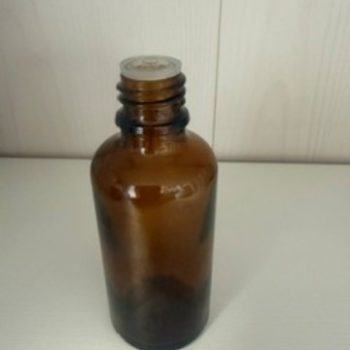
Amber glass bottle with DIN18 dispensing system

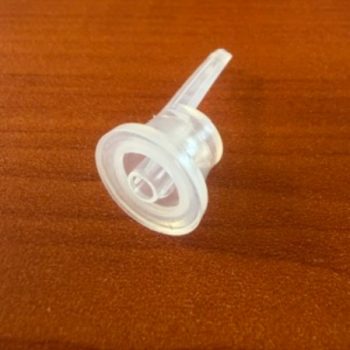
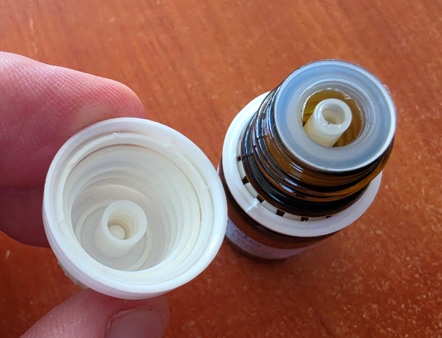
The recorded configuration comprised a 50 ml amber glass bottle, a DIN18 LDPE dropper and an HDPE safety cap with a specially shaped internal feature.

ATTEMPTED DIRECT-SEAL DESIGN

Bore/cone-style sealing feature

The feature was intended to surround the raised edge of the DIN18 dropper and create a direct seal; however, this configuration did not provide reliable leak resistance.

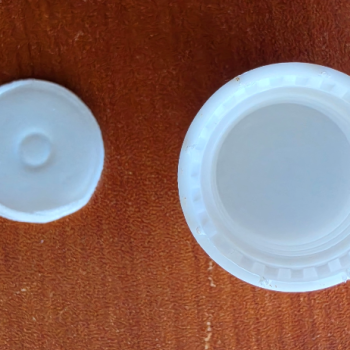
Initial configuration: the shaped feature inside the cap was designed to engage around the raised DIN18 dropper opening and form a direct seal. This configuration leaked under the assessed conditions.
SUCCESSFUL CORRECTIVE CONFIGURATION

Cap with an EPE foam sealing disc

The successful solution was a cap incorporating an expanded polyethylene (EPE) foam sealing disc. Under closure torque, the compressible disc formed a more uniform sealing interface over the dropper and helped accommodate dimensional variation between components.

amber-bottle
Open bottle with the dispensing insert fitted
din18-dropper
DIN18 dispensing insert
closure-interfaces
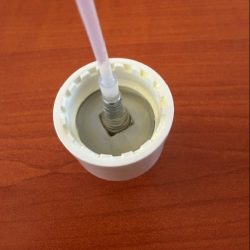
Inside of the closure showing the successful EPE foam sealing interface

Experimental evidence and why sample size matters

A related ANAVERIS assessment provides experimental evidence for this principle. An oil-based product was filled into 50 ml glass bottles fitted with a DIN18 inner dropper and a polypropylene closure. Although the assembled packs appeared acceptable during normal handling, horizontal storage under a partial vacuum of 250 mmHg for 2 hours resulted in leakage from the closure area in 8% of the tested packs.

A result of this type may not be detected when only two or three bottles are examined: at an observed failure rate of 8%, such a small sample could easily contain no leaking unit and create false confidence in the packaging system. A larger, predefined sample is therefore essential for identifying occasional leakage and component-to-component variation; as an initial practical screening point, testing at least 20 production-representative bottles provides a more meaningful basis than testing only two or three, while final validation should still be defined according to product risk, batch size, distribution route and acceptance criteria.

Interpretation, corrective action and limits

This finding demonstrates the effect of changing the sealing interface in this specific bottle–closure system; it does not establish that every DIN18 pack requires the same disc or that one disc material is suitable for every oil. The conclusion remains limited to the tested formulation, bottle, inner dropper, closure, sealing disc, torque and test conditions.

PRACTICAL LEARNING

A closure geometry that appears technically sound may still fail under challenge testing. In this case, the specially shaped closure leaked, whereas the EPE foam sealing disc achieved the required seal. Evaluate alternative configurations using a sufficiently large, production-representative sample under predefined conditions that reflect intended storage, transport and use.

CASE STUDY 02

Amber PET bottle with tamper-evident closure and pourer

The recorded configuration used an amber PET bottle with a tamper-evident HDPE closure and an LDPE pourer. The original assembly appeared correctly fitted but occasionally leaked during use. This is a useful example of why components that look compatible — and can be assembled without difficulty — do not necessarily form a reliable sealing system.

FIGURE 1 · ORIGINAL ASSEMBLY

Bottle, pourer and closure assembly that occasionally leaked

amber-pet-original
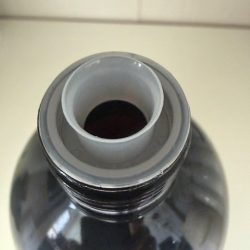
Oil-filled bottle fitted with an internal pourer
original-closure-interior
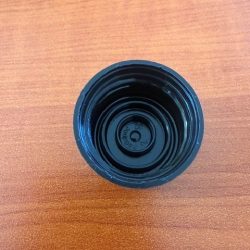
Inside of the original screw closure
pourer-neck
The pourer remains permanently retained while the closure is removed

Sealing performance did not depend solely on how tight the closure felt. ANAVERIS reviewed the interaction between the bottle finish, pourer, closure and application conditions to identify where the original system was losing sealing reliability.

VALIDATED PACKAGING REDESIGN

From a visible symptom to a system-level correction

Alternative closure configurations were evaluated and compared under controlled conditions. A modified configuration corrected the leakage observed with the original assembly and worked successfully under the assessed conditions.

The detailed internal geometry and component specification are intentionally not reproduced here. The correct solution cannot be selected from a photograph or transferred safely from one pack to another; it depends on the complete dimensional stack, formulation, component tolerances, filling process and intended use.

KEY ENGINEERING LESSON

Finding components that fit together is not the same as engineering a package that seals reliably. The critical step was to identify the weak interaction, compare suitable alternatives and verify the modified system under representative conditions. Product-specific recommendations require assessment of the complete formulation–packaging combination.

CASE STUDY 03

PET-G bottle with spray closure and EPE sealing disc

The recorded configuration used a transparent PET-G bottle, a spray closure and an expanded polyethylene (EPE) foam sealing disc. Unlike Cases 1 and 2, this example does not compare an unsuccessful assembly with a corrective redesign. It demonstrates a configuration that worked successfully under the assessed conditions and shows how a compressible sealing element can support leak resistance in a spray pack.

FIGURE 1 · ORIGINAL ASSEMBLY

Bottle, pourer and closure assembly that occasionally leaked

petg-spray
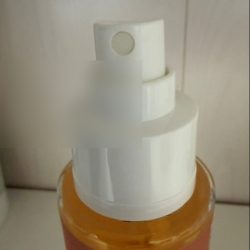
Transparent PET-G spray pack; visible label information has been anonymised
spray-disc
EPE foam sealing disc at the neck-sealing interface
spray-assembly
Side view showing the complete dispensing assembly

How the successful seal is formed

PRACTICAL LEARNING

A case study does not need to begin with a failed closure to provide useful engineering evidence. This PET-G spray pack worked because the bottle finish, spray closure and compressible EPE foam disc functioned as one sealing system. The result remains specific to the tested formulation, components, application conditions and use scenario and should be confirmed through representative validation.

CASE STUDY 03

PET-G bottle with spray closure and EPE sealing disc

The recorded configuration used a transparent PET-G bottle, a spray closure and an expanded polyethylene (EPE) foam sealing disc. Unlike Cases 1 and 2, this example does not compare an unsuccessful assembly with a corrective redesign. It demonstrates a configuration that worked successfully under the assessed conditions and shows how a compressible sealing element can support leak resistance in a spray pack.

FIGURE 1 · ORIGINAL ASSEMBLY

Bottle, pourer and closure assembly that occasionally leaked

petg-spray
Transparent PET-G spray pack; visible label information has been anonymised
spray-disc
EPE foam sealing disc at the neck-sealing interface
spray-assembly
Side view showing the complete dispensing assembly

How the successful seal is formed

PRACTICAL LEARNING

A case study does not need to begin with a failed closure to provide useful engineering evidence. This PET-G spray pack worked because the bottle finish, spray closure and compressible EPE foam disc functioned as one sealing system. The result remains specific to the tested formulation, components, application conditions and use scenario and should be confirmed through representative validation.

Resolve the packaging system before scale-up.

ANAVERIS can review the formulation–packaging combination, closure system, filling parameters and assessment requirements before production.